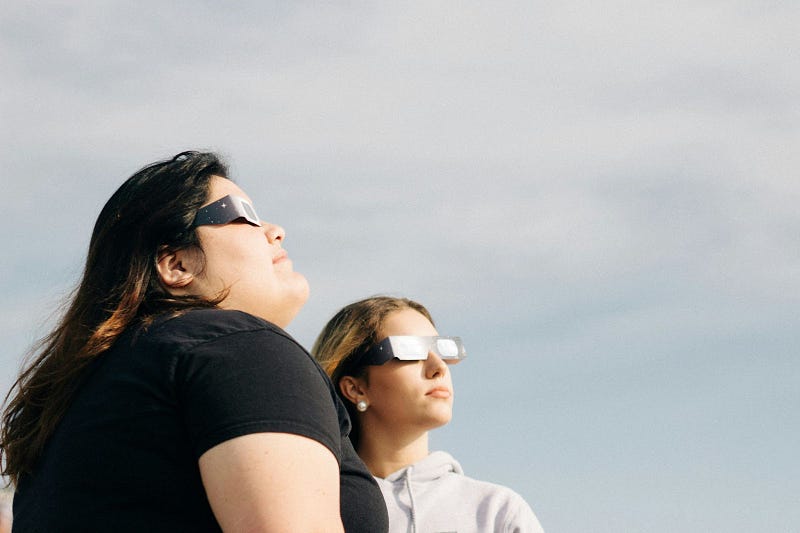
I was incredibly fortunate to experience the 2024 solar eclipse in optimal conditions. It was a warm spring day. The sky was clear. Montreal, the city I live in, was devoted to making this a communal experience, providing hundreds of thousands of eclipse glasses for free.
Most of the schools were closed so that people could watch it with their family. My son and I, and a couple of thousand fellow citizens gathered in a large city park. Spontaneous joy and clapping erupted throughout the city as we took our glasses off to see the magnificent illuminated orb that we could now only look at because the sun was entirely blocked.
According to Tibetan Buddhism, good karmic actions taken during a solar eclipse increase the positive impact a hundred million times. I can’t speak to actual truth of that, but the experience created a metaphor for my meditation practice that feels transformative.
I now think of my practice as a way of looking at my mind that is not unlike putting on a pair of eclipse glasses. If you think of the primal energy of the mind as luminous, spacious and powerful, way too powerful to look at it directly, then what we are ultimately trying to accomplish with meditation makes a lot more sense.
How obstacles protect us
Sustaining a meditation practice used to be tough for me. I went through the predictable cycle of wanting the focus, peace and sublime bliss that meditation promised, but with expectations that inevitably created disenchantment.
First there was the stage of giving up because I was overwhelmed by the distractions that I could now see more clearly. Thoughts, emotions and sensations seemed to become even more numerous and visible once I became aware of them through the very meditation I was using to get rid of them. It took me a while to realize there weren’t more of them. I was just seeing what had always been there.
When I got past that, I entered a new stage of pleasant, even intensely blissful experiences that I naively believed would last, and/or signified some kind of enlightenment, or lasting liberation from suffering. Of course they never did and often suffering seemed even worse after I’d experienced freedom from it.
As my practice matured, I hit the seemingly endless stage of wondering if my meditation was having any impact on my life. There was only one reliable test, seeing how quickly things fell apart if I stopped meditating. That left me in a limbo where I meditated mostly because I was afraid of what might happen if I didn’t.
I made it through that stage, and have been able to sustain a thriving practice thanks mostly to some excellent teachers who helped me finally see that meditation was not about self improvement, but rather about self discovery and transformation. Eventually I was able to recognize that meditation is not about making the mind bigger or better, but about seeing it as it is, and allowing it to shine as it was meant to. Paradoxically, once I stopped trying to change it, my life changed for the better. I developed a confidence in a basic well-being that I knew I could depend on, and found ways to leverage that to feel more secure, connected and productive.
Before I got to that stage, however, I had to recognize how the dull and dark spots of the mind have an inherent value in helping us to actually see the mind more clearly. Much in the same way that negative space, like the shadows an artist uses to create the illusion of depth and dimension, is essential to an artwork. Clarity is not always bright, it’s often dark. Sometimes even dim.
But just because you can’t see the sun doesn’t mean it’s shining with any less strength.
In fact if I were to gaze at the full force and energy of the mind, I might find my inner vision damaged in ways I could never have predicted. The dark night of the soul in the meditative journey is a real thing, and for some it never passes.
Putting on the meditation shades
I now think of most thoughts, emotions and sensations as kind of like ordinary sunglasses that do a good enough job for a while to distract me from all forms of annoying light. But they won’t shield me from the damage of not being able to effectively understand, or use, or respect the power of the sun.
Special eclipse glasses allow us to look directly at the sun and accurately chart the path of the solid mass that is blocking it. They allow us to see when it is safe to take the glasses off and look directly at the darkness so that we can see the wondrous glow that continues to illuminate it. And when we put them back on, they allow us to watch the block pass, so we can look once more on the sun and see how the block is always moving. Whether it is a cloud or a moon, these light reducing objects do not stick around.
The same can be said of every object, thought, emotion or sensation that we cling to, or try to avoid. If we put our glasses on enough times we recognize and eventually assimilate the truth that we don’t have to do anything much beyond seeing the darkness as it is and allowing it to naturally move on.
Living with insight
Once you get that, you don’t have to stare at the sun to understand or maintain the power of the mind. Much like a civilization that never went back to believing that the earth was the center of the universe once it understood the true position of the sun, we don’t have to work at sustaining a belief that resonates with truth.
The mind is powerful. You don’t have to stare at it, add more light to it, or make it bigger or better.
You just have to let it radiate through all physical, emotional and mental states, even those that you might ordinarily experience as unpleasant.
Once you have insight, practice isn’t about relieving suffering, or blissing out. Practice is about letting things be as they are, and in doing that, allowing for the natural expansion of the resources that you’ve always had.
 Clear Path Learning
Leave a comment