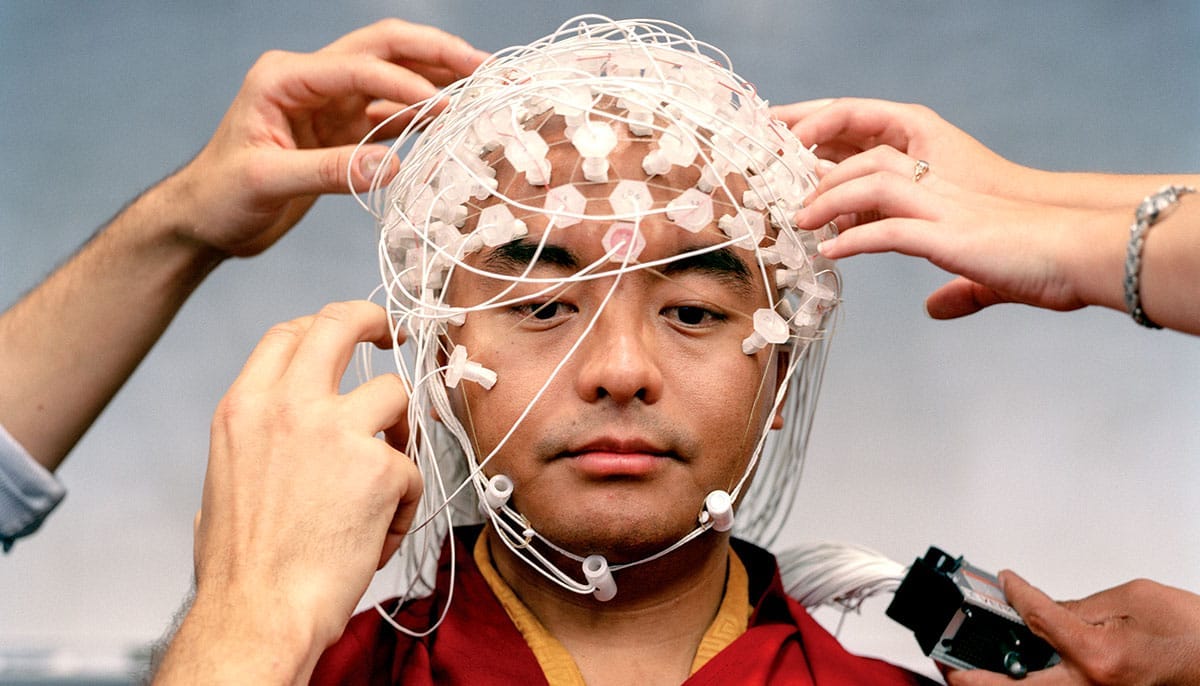
About 20 years ago a group of neuroscientists put a young monk into an fMRI machine because they wanted to see if his brain behaved any differently than ordinary western brains. What they saw was so unusual that they had to take their system apart to make sure there were no glitches to explain it. Up until that point they’d never seen anyone who had the ability to activate and sustain gamma oscillations, brain activity associated with happiness, insight, and cognitive thriving, in the way this monk was able to do.
Of course he was no average monk, he was the son of one of the most respected Tibetan meditation teachers of the 20th Century. But Mingyur Rinpoche had been meditating from a young age, not just because it was the family business. As a child and throughout his early teens, he suffered from crippling panic attacks. Meditation was the only way he knew to find relief and ultimately freedom from his high levels of anxiety.
While an fMRI is the tool western science uses to see inside the brain, meditation is the tool that Tibetan buddhism uses to see into the mind. What Mingyur Rinpoche sees when he’s activating and sustaining these gamma waves is what he describes as “innate well-being,” a stable state of awareness that exists for all of us, but that we just don’t recognize, the way fish don’t recognize water as water. It’s too close and too ubiquitous.
Soon after his experience in the fMRI, Mingyur Rinpoche saw the need for a secular meditation program that westerners could follow that would help them to recognize and leverage this innate well being to better navigate the turbulent culture they lived in. Joy of Living, based on his book of the same name, takes the basic framework that’s been forged over a teaching lineage covering roughly two millennia, strips it of rituals, chanting, any any iconography that might be distracting in a secular world, and offers it as part of a personal learning community platform called Tergar (a fusion of the Tibetan words Ter for treasure and gar for gathering).
Developing wisdom
When I discovered this program over ten years ago, I didn’t believe that I had innate well being. I was a journalist watching the newspaper and magazine industry that had been the bedrock of my financial well being evaporate into the sands of social media. I was also a single mother feeling sucked into a financial hole beyond my control. I felt no solid emotional ground. Fostering a belief that everything was essentially okay felt like denial of the fearful direction the world was heading in.
But I was determined to take a leap. Back before the release of the first smartphones, I’d interviewed the Harvard psychologist Dan Gilbert about his book Stumbling On Happiness. One of the big takeaways I’d remembered from the book was that if you wanted to be happy, learn from someone who is actually happy. I had no interest in the many people who were pretending to be happy online with their facebook pictures and enthusiastic tweets. I wanted to find someone who had some hard data to back up his claims.
There were skills other than meditation that I learned in the years following the year I discovered Mingyur Rinpoche and his program (yes, I learned to code!); but navigating life as a middle aged woman in a fast growing start up, where I eventually became Chief Learning Officer, took way more than knowing how to code. I needed a set of socio emotional skills, awareness, compassion and above all confidence in the one thing I knew with certainty I could bring to the table, wisdom.
Anytime, Anywhere
The program that Tergar offered truly encouraged me to meditate anytime anywhere. I kept my smartphone, but I turned off all my notifications. When I felt the urge to check, unless it was actually related to deep work, or an interest that wasn’t too derailing, I meditated. Sometimes I reconnected with the present. Sometimes I took a minute to remember that everyone wants to be happy. Sometimes I took a minute to set the intention to remain digitally wise, wherever my job promoting digital literacy took me.
In the decade since I joined the Tergar community, I have meditated at -40C beneath the northern lights of Nunavut, a territory the size of Mexico, with a population of less than 40,000. I have meditated while looking out over the savannah in Kenya, where our species orginated. I’ve meditated in downtown L.A. And when COVID hit, I meditated before taking the stage (virtually) at a UNESCO conference in Beijing.
A tool for seeing the extraordinary
Over time I’ve started to see it. Not the light an fMRI sees when it looks inside the mind of an extraordinary meditator, but the more stable light that extraordinary meditators see when they perceive what exists in an “ordinary” mind.
As we build our technological tools in the era of AI, being able to see and maintain the recognition of the wisdom that shines within and around every human mind is the skill we will all need. But we also need the maps that strong programs like Tergar provide to support this skill.
The data led me to this one. And the data continues to be good. The longitudinal study continued over the twenty since he first entered the fMRI shows that Mingyur Rinpoche’s brain is aging far more slowly than normal.
Trusting that data and following this map has remained one of the best decisions I’ve ever made.


Leave a Reply